Warehouse Workforce
Workforce Schedule Adherence in Dispensary Distribution
Workforce Schedule Adherence in Dispensary Distribution
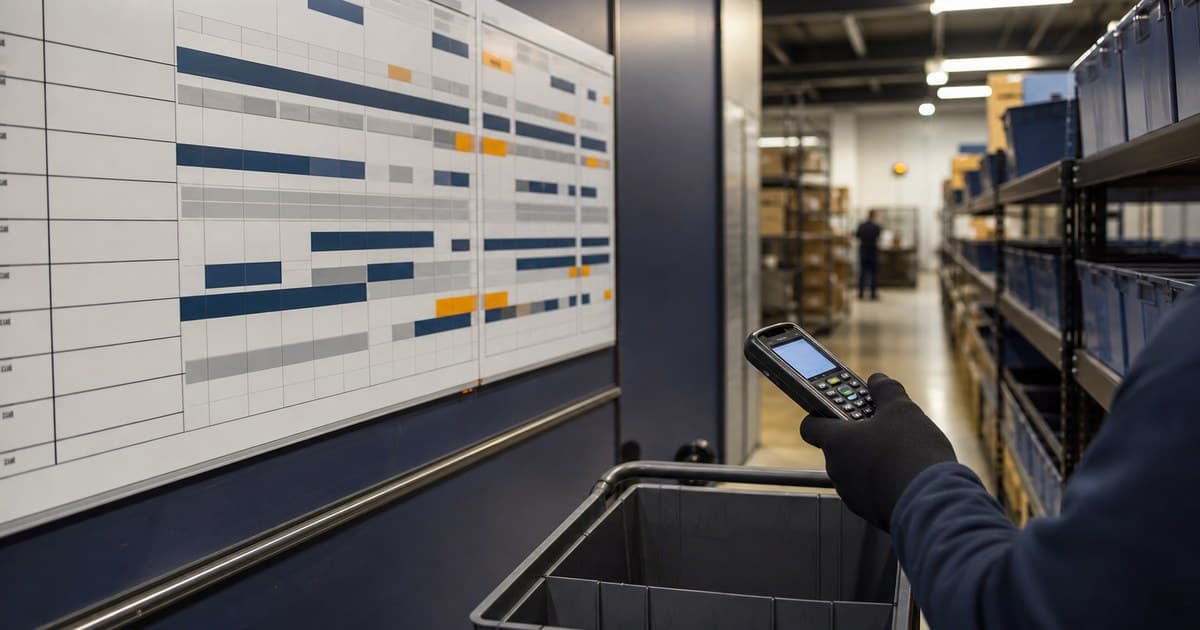
Can a dispensary distribution operation measure warehouse schedule adherence without turning a planning timestamp into a judgment about an individual worker? The question matters because a schedule can describe a pick wave, receiving appointment, cycle count, training block, or sanitation task. Actual work may shift for safety, inventory, customer, or equipment reasons. A fair record must preserve those changes rather than treat every deviation as failure.
This article studies measurement design for distribution support. It does not evaluate a workforce, recommend staffing levels, calculate productivity, or provide employment advice. It distinguishes attendance, assignment status, paid time, task output, quality, and safety because each answers a different operational question.
Method and sources
The research was reviewed on August 23, 2026 using the NIST Engineering Statistics Handbook (opens in a new tab), the U.S. Bureau of Labor Statistics Occupational Safety and Health Statistics (opens in a new tab), OSHA recommended practices for safety and health programs (opens in a new tab), the ASQ quality glossary (opens in a new tab), ISO quality management principles (opens in a new tab), and GS1 standards for supply-chain visibility (opens in a new tab). The public sources frame measurement, safety, quality, and operational visibility. They do not establish a target, labor result, or employment policy for a named organization.
The method separated the planned event from the observed status, listed legitimate exceptions, and tested what could be concluded from a time record alone. No timekeeping, warehouse-management, safety, or quality data were supplied. The evidence scope is therefore a reproducibility review, not a benchmark study.
Define the planned event
The plan should identify the activity, location or zone, start and end interval, required capability, priority, and responsible planning role. “Work the morning shift” is too broad to test adherence to a receiving appointment or a pick wave. A useful plan states the event that matters and the evidence expected when the event changes.
Plans also need version history. A queue may be resequenced after an inbound delay or an urgent order. If the plan is overwritten, the later report may call the operation late against a schedule that no longer existed. Preserve the original plan, the approved revision, time of revision, and reason. That history allows a reviewer to distinguish a planned change from an unrecorded deviation.
Define the observed status
Observed status can include started, completed, waiting for material, reassigned, in training, on an approved break, stopped for safety, or not recorded. These labels should describe what the evidence shows. “Unproductive” is an interpretation that may be unsupported by a time stamp. The status dictionary should be agreed before the measure is reported.
Attendance and adherence should remain separate. A person may be present but reassigned to a safety inspection. A person may be absent under an approved policy while the team’s schedule is updated. Combining those records can create an unfair operational story and conceal a planning issue.
Context that changes interpretation
Task complexity affects output and elapsed time. Receiving a mixed inbound shipment, resolving an identifier mismatch, or inspecting a return is not equivalent to scanning a uniform case. The measure should not compare intervals as though they represent identical work. Retain task type, unit, exception, and quality check where those factors matter.
Indirect work deserves the same clarity. Equipment checks, replenishment, cleaning, documentation, coaching, and issue resolution can support fulfillment without appearing as a picked line. If the schedule excludes those activities, the report may call necessary work a deviation. If the schedule includes them, the record should show the assignment and expected evidence.
Safety is a boundary, not a performance penalty. OSHA guidance emphasizes managing hazards and involving workers in safety programs. A stop, inspection, or reassignment made for safety should be recorded as such. A schedule measure should never create an incentive to bypass a safety control in order to preserve a timestamp.
Analysis model
The fact is the planned interval and the captured status. The analysis is the comparison between them under the documented rules. The interpretation asks why the interval changed and whether the pattern is useful for planning. Those steps should be visible in a report. A single percentage without the denominator, exclusions, and status definitions is not reproducible evidence.
A defensible review can examine missed starts, early finishes, waiting states, reassignment, and missing records separately. It can compare planned work with completed work only when the unit and quality rule are clear. It should also show the number of intervals that could not be classified. Excluding unknowns without disclosure makes a measure look cleaner while weakening its meaning.
The review should protect worker privacy while retaining enough operational context to study the process. A team can often analyze assignment, zone, task type, and interval without exposing a person’s identity in a general planning report. Access to detailed time records should follow the organization’s policy. Privacy boundaries are part of evidence quality because a measure that cannot be used responsibly will not produce a stable operating practice.
Limitations
Public sources cannot define local schedules, labor policies, privacy safeguards, or applicable employment requirements. Time clocks can be rounded, shared, offline, or edited. Warehouse systems may capture task scans but not planning decisions. This research does not evaluate individuals, compensation, staffing adequacy, or legal compliance, and it does not set a universal adherence threshold.
Evidence-led conclusion
Schedule adherence can support better distribution planning when it compares a versioned plan with an explicit observed status and preserves reassignment, waiting, safety, quality, and unknown conditions. It is not attendance, productivity, or a verdict about a person. For dispensary distribution, the evidence-led approach is to define the event, protect exception context, and read the measure alongside quality and safety records before changing an operating decision.
Related Reading
| Evidence check | Record to inspect | Interpretation boundary |
|---|---|---|
| Planned work | Versioned assignment and interval | Does not prove attendance |
| Observed status | Task, exception, quality, and safety context | Does not prove productivity |
Sources
- NIST Engineering Statistics Handbook (opens in a new tab)
- BLS Occupational Safety and Health Statistics (opens in a new tab)
- OSHA Safety and Health Programs (opens in a new tab)
- ASQ Quality Glossary (opens in a new tab)
- ISO Quality Management Principles (opens in a new tab)
- GS1 Standards (opens in a new tab)
- U.S. Department of Labor workplace safety resources (opens in a new tab)
- National Institute for Occupational Safety and Health (opens in a new tab)
Frequently Asked Questions
What does schedule adherence measure?
It compares an approved planned interval with a defined observed status, using rules for assignments, exceptions, and time capture.
Is schedule adherence the same as attendance?
No. Attendance describes presence under a policy, while adherence concerns alignment with a specific planned work assignment or interval.
Can adherence alone prove warehouse productivity?
No. Quality, safety, task complexity, indirect work, and service outcomes provide necessary context.