Distribution Controls
Cold-Chain Excursion Records for Dispensary Distribution
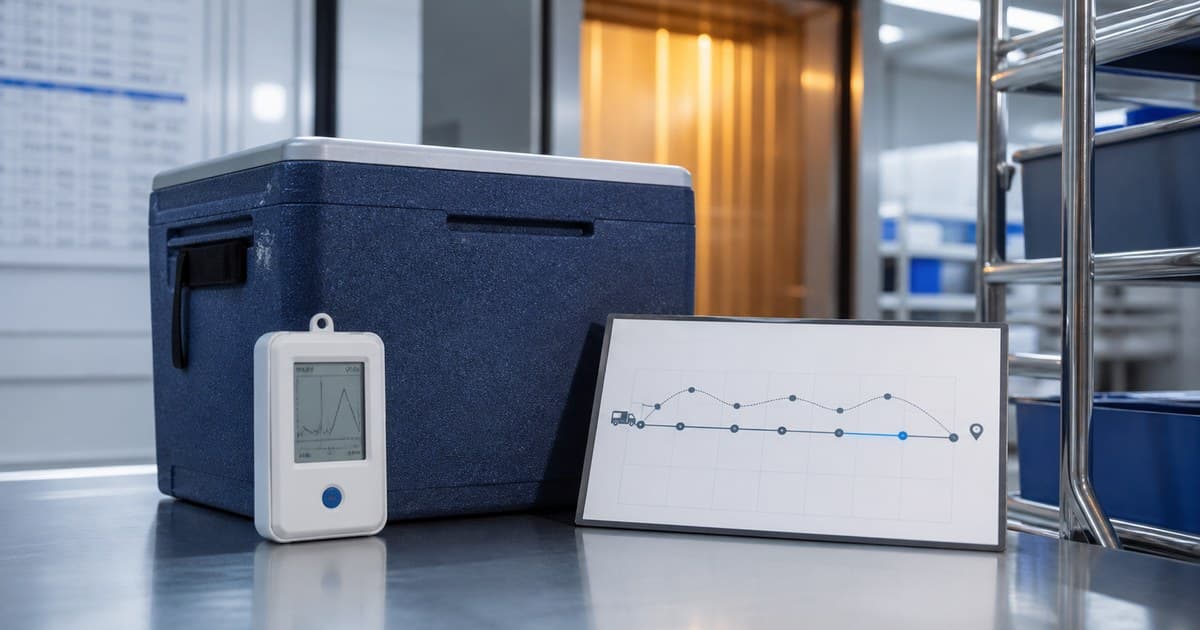
Cold-Chain Excursion Records for Dispensary Distribution
When a dispensary distribution shipment produces a temperature alarm, can the available record show what happened without overstating what the sensor proves? The question is practical because a shipment may pass through storage, staging, loading, transport, and receiving. A sensor reading identifies a condition at a point in that chain. It does not, by itself, establish product impact, cause, or disposition.
This note studies the evidence needed to interpret a cold-chain excursion record. It concerns distribution coordination and record quality. It does not state storage limits for any product, prescribe handling of regulated goods, or determine whether a shipment is acceptable. Those decisions belong to the responsible organization and applicable requirements.
Method and evidence scope
The review was completed on August 23, 2026 using the U.S. Pharmacopeia general information on good storage and distribution practices (opens in a new tab), WHO guidance on temperature-sensitive pharmaceutical products (opens in a new tab), the FDA Drug Supply Chain Security Act resources (opens in a new tab), GS1 traceability standards (opens in a new tab), the NIST Engineering Statistics Handbook (opens in a new tab), and ISO quality management principles (opens in a new tab). The sources were used to frame traceability, measurement, custody, and quality concepts. They do not provide a result for one distributor.
The method separated four evidence layers: sensor observation, shipment identity, custody timeline, and decision record. I then tested whether each layer could be connected to the others and marked the conclusions that require information outside a generic sensor export. No private logger files, product specifications, route records, or state inspection records were reviewed. The article therefore evaluates a repeatable review model rather than an excursion rate.
The sensor is one witness, not the whole case
A logger may record temperature at a chosen interval, with a device identifier, time zone, and calibration or verification context. Those details matter. A value without its unit, timestamp, sensor identity, or sampling interval is difficult to interpret. A dashboard alarm may summarize a series but should not replace the underlying readings when a disposition decision depends on duration or peak value.
The reading also has a physical location. A probe in a tote, a vehicle, a staging area, or a room measures different environments. Its placement, shielding, battery state, and contact with the product or packaging can affect what it observes. The public sources support documenting measurement context, but an operation must maintain its own approved monitoring method.
Identity connects the reading to the shipment
The excursion record should link to a shipment, order, container, and, where required, lot or other product identity. A logger downloaded without a shipment identifier may be technically valid but operationally unactionable. A single shipment can also contain multiple containers or zones. The identity rule should state whether one alert applies to all contents or only to the monitored unit.
Receiving records add another identity check. A receiver can compare the transport identifier, package condition, seal or container information, and the sensor record. If identifiers disagree, the discrepancy is itself part of the evidence. It should not be silently repaired by changing the logger filename or copying a number into a receiving note.
Custody and timing
The custody timeline should distinguish pack or staging, load, departure, route interruption, arrival, and receipt. A temperature value becomes more useful when a reviewer can place it alongside those events. A spike during an open-door loading event may require a different investigation from a sustained reading during a route delay. The timeline does not automatically establish cause; it narrows the questions that should be asked.
Time handling needs explicit rules. Device time, system time, and local operating time can differ. Daylight-saving transitions and offline uploads can make an event appear out of sequence. Preserve the original timestamp and record any normalization used for analysis. A report that shows only a converted time can hide the difference between the device’s observation and the analyst’s display.
Decision record
The final layer is the response: alert acknowledged, shipment isolated or not, reviewer, evidence considered, decision, and date. The decision should refer to the approved product and storage requirements rather than an invented general threshold. If the required information is missing, “undetermined pending review” is more accurate than a confident pass or fail.
This separation also keeps facts distinct from analysis. The fact may be that a sensor recorded a value outside a configured band for a stated duration. The analysis may note that the event overlaps a loading interval. The disposition decision may require a qualified person to interpret product-specific evidence. A distribution support workflow can organize these records without taking the role of that decision owner.
Limitations
Public guidance does not validate a particular logger, packaging configuration, route, product, or state requirement. Sensor data may be incomplete, delayed, or affected by calibration and placement. A temperature record cannot establish product quality on its own. This research also does not examine cybersecurity of monitoring devices, chain-of-custody legal requirements, or the performance of any carrier.
Evidence-led conclusion
A cold-chain excursion record is strongest when four links remain intact: the sensor observation, the shipment identity, the custody timeline, and the authorized decision. An alarm alone is evidence of an observed condition, not a verdict about product impact. For dispensary distribution, the defensible practice is to preserve raw readings and context, document missing evidence, and route product-specific disposition to the responsible qualified reviewer.
Related Reading
| Evidence check | Record to inspect | Interpretation boundary |
|---|---|---|
| Observation | Raw sensor reading and device context | Does not prove product impact |
| Decision | Review, disposition, and owner | Requires approved product criteria |
Sources
- U.S. Pharmacopeia (opens in a new tab)
- WHO temperature-sensitive pharmaceutical products guidance (opens in a new tab)
- FDA DSCSA resources (opens in a new tab)
- GS1 Traceability Standards (opens in a new tab)
- NIST Engineering Statistics Handbook (opens in a new tab)
- ISO Quality Management Principles (opens in a new tab)
- U.S. National Library of Medicine temperature resources (opens in a new tab)
- CDC vaccine storage and handling resources (opens in a new tab)
Frequently Asked Questions
What belongs in a temperature-excursion record?
Retain the shipment or lot identity, sensor source, observed time and value, custody context, alert handling, and approved disposition decision.
Does one sensor alarm prove product damage?
No. It proves an observed condition in that sensor’s record. Product-specific interpretation requires the approved limits and qualified review.
Why separate transport and receiving temperatures?
They occur at different custody points and can reveal different conditions. Combining them obscures when and where an observation was made.