Reverse Logistics
Returns Condition Evidence Research: What Can an Inspection Record Actually Prove?
Research question
Which observations in a returns inspection record are strong enough to support a disposition review without overstating product condition?
Working thesis
A returns record is useful when it separates what was observed at receipt from the later interpretation and disposition decision.
Observation is not disposition
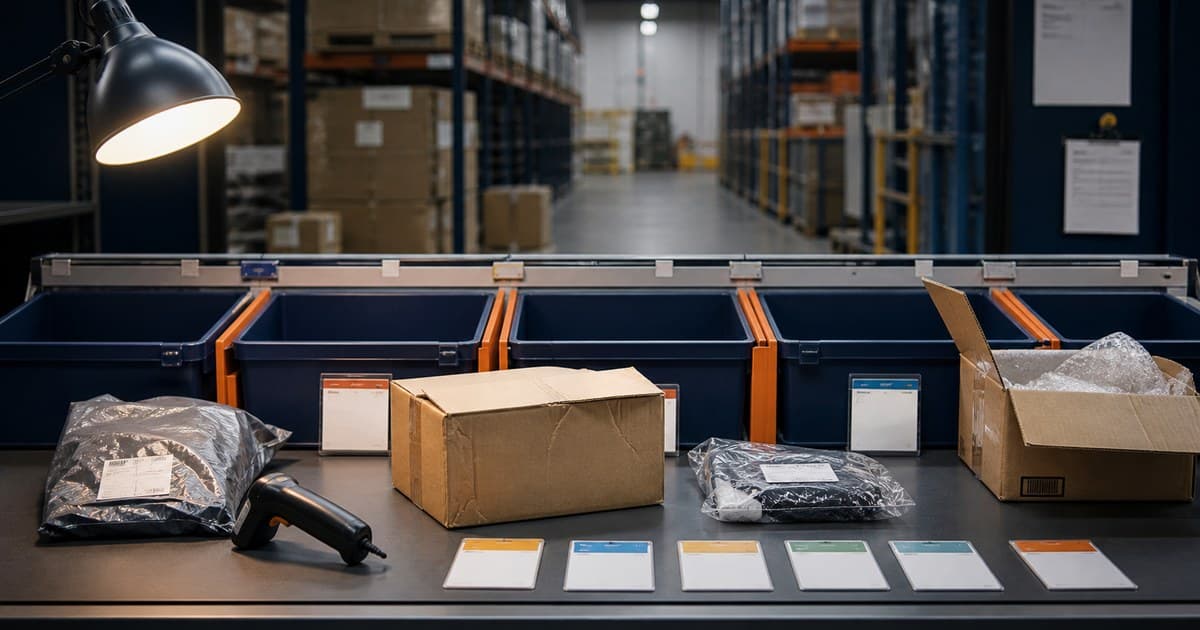
A package may arrive sealed, open, wet, crushed, incomplete, mislabeled, or accompanied by a customer description. Those facts matter, but none alone determines restock, repair, donation, destruction, or hold. State what was visible, under what conditions, and which identifiers were present. Disposition is a later decision with its own authority.
Quality principles support evidence that is usable and reviewable. They do not decide product suitability for every category. A photo or checkbox is not automatically a safety, warranty, or resale conclusion requiring no qualified review.
Describe the returned unit
Begin with order, authorization, item, serial or lot where applicable, quantity, packaging, and receipt time. Record missing identifiers instead of filling them from a likely match. Separate package, inner pack, product surface, function, accessories, and documentation.
Photographs preserve context but can omit odor, contamination, hidden damage, or functionality. Record tests performed and results in plain language. Do not state that an item is safe, authentic, compliant, or fit for sale without authorized support.
Use an unknown state
A condition vocabulary should distinguish observed damage from suspected cause and unknown condition. Crushed carton is observation; carrier damage is causal conclusion. Missing accessory is observation; customer misuse is attribution.
Disposition options retain reason and approving role. A hold is not proof of discard. A restock transaction is not proof that every test passed. Preserve transition and evidence so later review can reconstruct what was known.
Protect chain of custody
Time, handler, location, seal status, and transfer events explain what an inspection represents. Safety, contamination, hazardous-material, privacy, or regulatory concerns require the operation escalation path.
OSHA and FDA materials provide public context, not a client compliance finding. An analyst can flag missing evidence or unresolved escalation; the accountable owner decides.
Methodology and evidence scope
This review uses the public sources below as available on August 25, 2026 and applies their definitions and control principles to one bounded distribution-operations question. Statements about source material are facts; the proposed fields, comparisons, and escalation paths are analysis. The sources do not measure Global Distribution VA, a client facility, private records, staffing, contracts, financial outcomes, or testimonials. The scope covers evidence definition, record lineage, comparison limits, and role boundaries. It excludes local targets and decisions that require an accountable owner.
A local study should preserve its population, exclusions, source systems, verification date, missingness, definitions, approvals, and unresolved gaps. Administrative support may organize records and prepare an evidence brief. It must not invent facts, change commercial terms, release inventory, make safety determinations, promise service, or substitute for owner approval.
Visible sources
- https://www.fda.gov/food/food-safety-modernization-act-fsma (opens in a new tab)
- https://www.iso.org/quality-management-principles.html (opens in a new tab)
- https://www.osha.gov/warehousing (opens in a new tab)
- https://www.nist.gov/cyberframework (opens in a new tab)
- https://www.epa.gov/smartway (opens in a new tab)
- https://www.bts.gov/topics/freight-transportation (opens in a new tab)
- https://www.fmcsa.dot.gov/safety (opens in a new tab)
- https://www.cisa.gov/topics/cyber-threats-and-advisories (opens in a new tab)
- https://www.bls.gov/opub/hom/ (opens in a new tab)
- https://lpi.worldbank.org/ (opens in a new tab)
- https://www.transportation.gov/briefing-room (opens in a new tab)
- https://www.iso.org/standards.html (opens in a new tab)
- https://www.gs1.org/standards (opens in a new tab)
| Observation layer | Evidence | What it cannot prove alone |
|---|---|---|
| Package | Seal, damage, photograph | Cause or product suitability |
| Product | Identifier, condition, test | Safety or resale authorization |
| Disposition | Reason and approver | That every earlier fact was complete |
Related Reading
- Returns disposition evidence research
- Warehouse returns inspection research
Frequently asked questions
Does this research measure one company's performance?
No. It defines an evidence question and boundary; local findings require local records, approved definitions, and an accountable owner.
Can this article replace an operating procedure?
No. It supports a review, while responsible owners approve procedures, safety decisions, inventory changes, customer commitments, and permissions.
What should a reviewer retain?
Retain source URLs, verification date, population, definitions, exclusions, calculations, approvals, and unresolved evidence gaps.
Review design note
The inspection packet should also preserve the boundary between what a person saw and what a system later inferred. If packaging is discarded, a later reviewer may lose important context, so the retention rule and photograph reference belong with the record. A missing observation should remain visible rather than being reconstructed from the eventual disposition.
Evidence boundary in practice
The strongest packet keeps receipt, inspection, hold, test, transfer, and disposition events separate. If an item changes condition after receipt, the later observation should not be written back into the first record. This preserves uncertainty and helps an owner decide what additional evidence is needed. Record organization can improve review quality, but it cannot grant authority to release or dispose of a product.
The reviewer should record what was not inspected as carefully as what was inspected. A sealed inner package, unavailable serial number, failed device test, or missing photograph changes the evidence scope. Listing those limitations prevents a later reader from treating a partial inspection as a complete product assessment. It also provides a clear escalation question for the owner who must decide whether to test, hold, return, repair, or dispose of the item.
Conclusion
A returns record is useful when it separates what was observed at receipt from the later interpretation and disposition decision. The evidence supports a repeatable local review with explicit definitions and visible limitations; it does not establish a result, cause, compliance status, or target for any particular operation. Preserve the source record, route unresolved questions to the accountable owner, and treat missing evidence as a finding rather than filling it with a confident estimate.
Frequently Asked Questions
Does this research measure one company's performance?
No. It defines an evidence question and boundary; local findings require local records, approved definitions, and an accountable owner.
Can this article replace an operating procedure?
No. It supports a review, while responsible owners approve procedures, safety decisions, inventory changes, customer commitments, and permissions.
What should a reviewer retain?
Retain source URLs, verification date, population, definitions, exclusions, calculations, approvals, and unresolved evidence gaps.