Cannabis Retail Operations
Cannabis Barcode Scan Failure Research: What Should a Dispensary Reconcile?
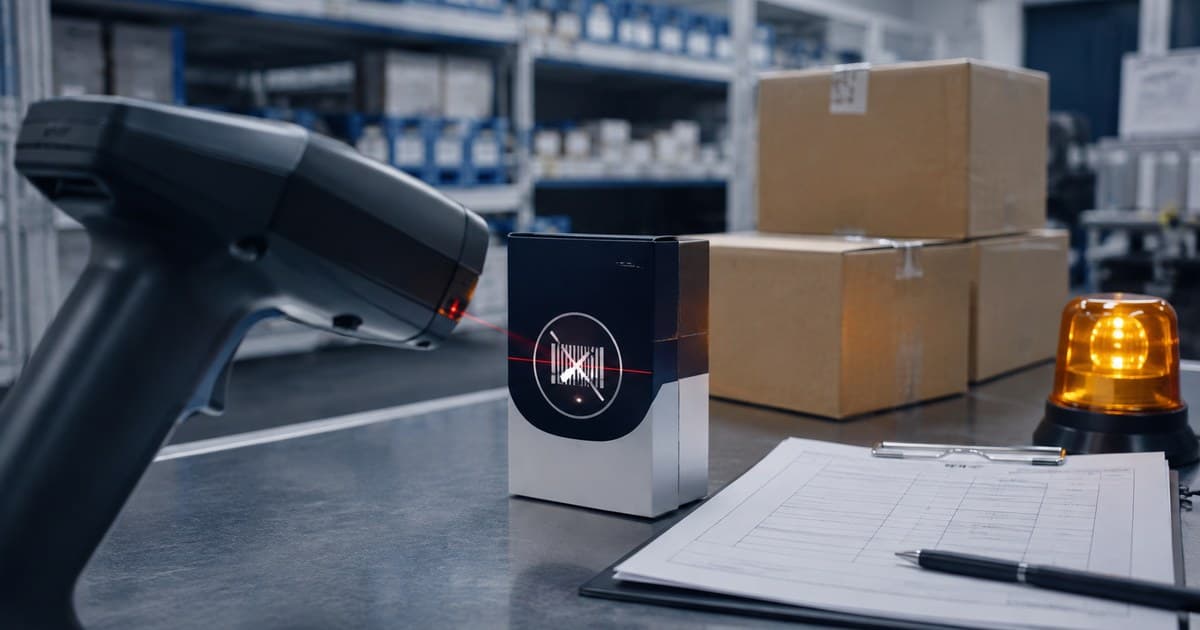
Research question
What should a cannabis dispensary reconcile when a barcode will not scan? The tempting answer is to type the number, continue receiving, and fix the record later. That shortcut can turn a damaged label, wrong product, wrong lot, duplicate identifier, or unregistered item into an unexplained inventory change. The research question is: which facts distinguish a recoverable scanning problem from an identity exception that must remain held for review?
Why the scan is only one piece of evidence
A barcode is an encoded representation, not the product itself. It can be obscured by packaging, printed at low contrast, associated with a different packaging level, or mapped incorrectly in a local system. The Virginia Cannabis Control Authority provides jurisdictional context for regulated cannabis operations. California’s Department of Cannabis Control shows another jurisdiction’s inventory and labeling expectations. GS1 explains identification keys and barcode quality concepts, while NIST’s digital identity and risk material helps frame authentication and auditability. These sources describe principles; none validates a specific dispensary’s product.
The operational analysis is that a scan failure should open an exception record with three layers. First is observation: what the operator saw and what the device returned. Second is identity evidence: package label, product name, lot, quantity, and any authorized traceability identifier. Third is authority: who can approve a manual recovery, hold, or adjustment. Collapsing those layers into “barcode failed” leaves no way to distinguish a label defect from a master-data defect.
A recovery decision model
If the label is smudged but the identifier is legible and agrees with the receiving document, a second scan angle, clean lens, or approved manual entry may be appropriate. If the printed identifier disagrees with the purchase or transfer record, stop the transaction and preserve both identifiers. If the code scans to a different product or lot, treat the mapping as unresolved. If the package is damaged or the required label information cannot be read, keep the unit in a controlled status until the accountable owner decides the route.
The quantity matters. One failed unit in a case is not equivalent to an entire pallet with a repeated failure. Record the unit of measure and packaging hierarchy. A case barcode may identify the outer logistics unit while a retail package carries the sellable identity. A reconciliation that records only the total case count can conceal a conversion error. Photos may support observation, but they do not substitute for an approved identity record and should not expose customer or sensitive information.
Methodology and evidence scope
This review compared public Virginia CCA, California DCC, GS1, NIST, and FDA barcode and traceability materials available on August 23, 2026. It converts their identity, traceability, and record-integrity themes into a proposed exception sample: compare successful and failed scans across receiving, transfer, cycle count, and sale preparation; classify the cause; and measure time to accountable resolution. No private device logs or regulated inventory records were examined. The model is a research interpretation, not a mandated metric.
| Scan outcome | Preserve | Next decision |
|---|---|---|
| Label readable, match confirmed | Identifier and second check | Approved recovery path |
| Code maps differently | Both identifiers and source record | Hold for identity review |
| Label unreadable | Observation, quantity, and location | Accountable disposition |
Facts versus analysis
The fact is that identifiers and records support traceability and reconciliation. The analysis is that a useful exception report should not measure scan success in isolation. Pair scan success with match rate, manual-entry rate, repeat-failure rate, unresolved age, and adjustment rate. A high success rate can still be unsafe if the few failures are concentrated in one product or lot. A high manual-entry rate may indicate poor labels, poor master data, or an approved accessibility accommodation; the reason must be visible before someone interprets it.
Operations support can collect the evidence, compare the receiving record, route a held item, and maintain the exception queue. It should not decide whether a product is legally saleable, invent a lot relationship, or approve a regulated inventory adjustment outside delegated authority. The owner of inventory, quality, compliance, or the applicable traceability system must set the rule and approve consequential changes.
Trend the exception by device, label format, supplier, product family, packaging level, and location only when those dimensions are supported by the record. A cluster may indicate a printer or master-data issue, but it is still an inference until tested. Preserve the original failed transaction and any corrected transaction as linked events. Overwriting the first attempt removes the evidence needed to distinguish a careful recovery from an unexplained change in regulated stock.
Limitations and conclusion
Barcode standards do not describe every cannabis package, local software mapping, or state-specific workflow. A visual match can be misleading, and a scanner can succeed while a record remains wrong. Public sources also cannot establish the quality of a label in one operation. The proposed categories should therefore be tested against local evidence and reviewed by the accountable owner.
The evidence supports a bounded conclusion: a failed cannabis barcode scan is safest when treated as an identity question before it becomes a data correction. Preserve the observation, reconcile the product and lot context, distinguish packaging levels, and make approval visible. That approach gives distribution and dispensary teams a defensible record without asking an administrative recovery step to make a compliance or product-safety decision.
Visible sources
- Virginia Cannabis Control Authority (opens in a new tab)
- California Department of Cannabis Control (opens in a new tab)
- GS1 identification standards (opens in a new tab)
- NIST Cybersecurity Framework (opens in a new tab)
- FDA Food Traceability Final Rule (opens in a new tab)
Frequently Asked Questions
What should staff record after a failed scan?
Record the item identifier, lot or batch information when applicable, scan time, device or system response, quantity, and the next accountable handoff.
Can staff type the code manually?
Manual entry may be an approved recovery path, but it needs a second identity check and a retained reason for bypassing the scan.
Is every scan failure a compliance event?
No. It is an operational exception that may reveal a compliance risk and should be evaluated under the applicable program and policy.